Sunglasses Manufacturer | OEM & ODM Eyewear Factory | Seesun
Sunglasses Manufacturer | OEM & ODM Eyewear Factory | Seesun
PRODUCT DEVELOPMENT
A pronounced acetate front curve can look right in a drawing and still fail a lens-fitting check. On another frame, the metal temples may align on paper but open at different angles after assembly. Both problems belong in development, before production tooling and schedules are fixed.
Custom eyewear development begins by turning a visual brief into drawings that can be checked, sampled and revised. The approved physical frame then has to be matched to a controlled production specification; a good-looking prototype by itself is not enough.
Three completed SEESUN projects illustrate the decisions involved: a curved acetate front, an acetate–metal hinge connection and a patterned acetate construction.
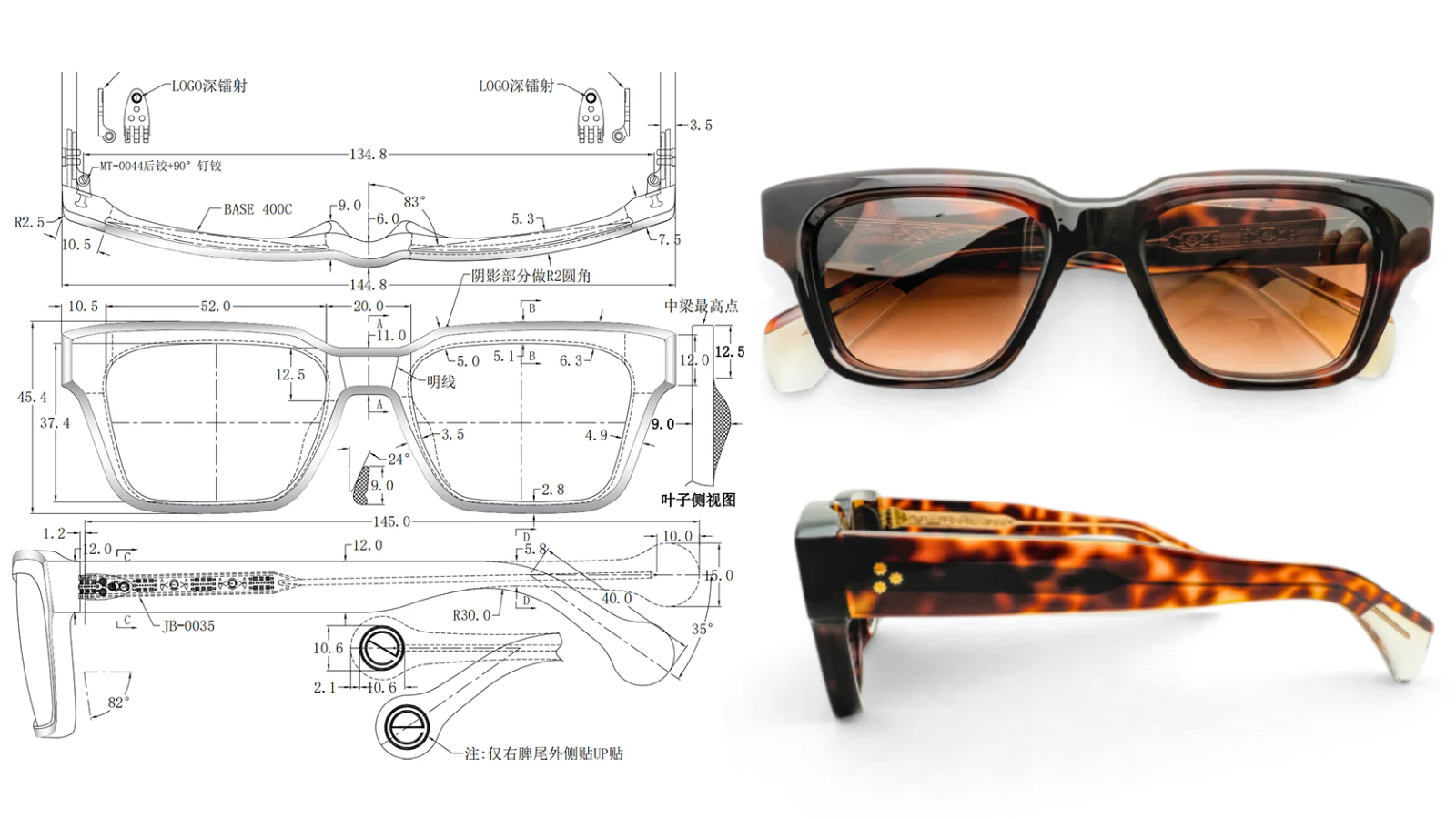
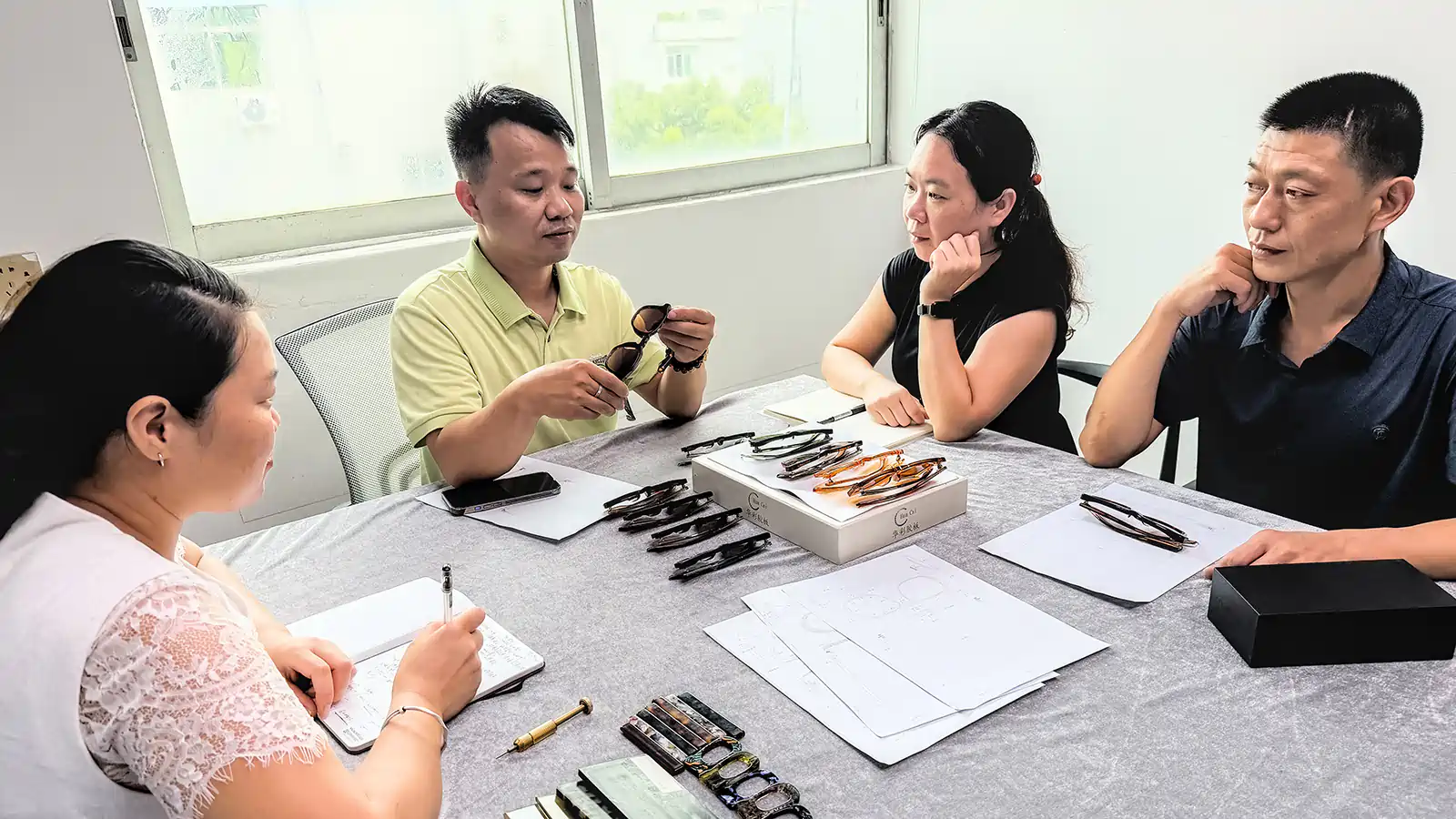
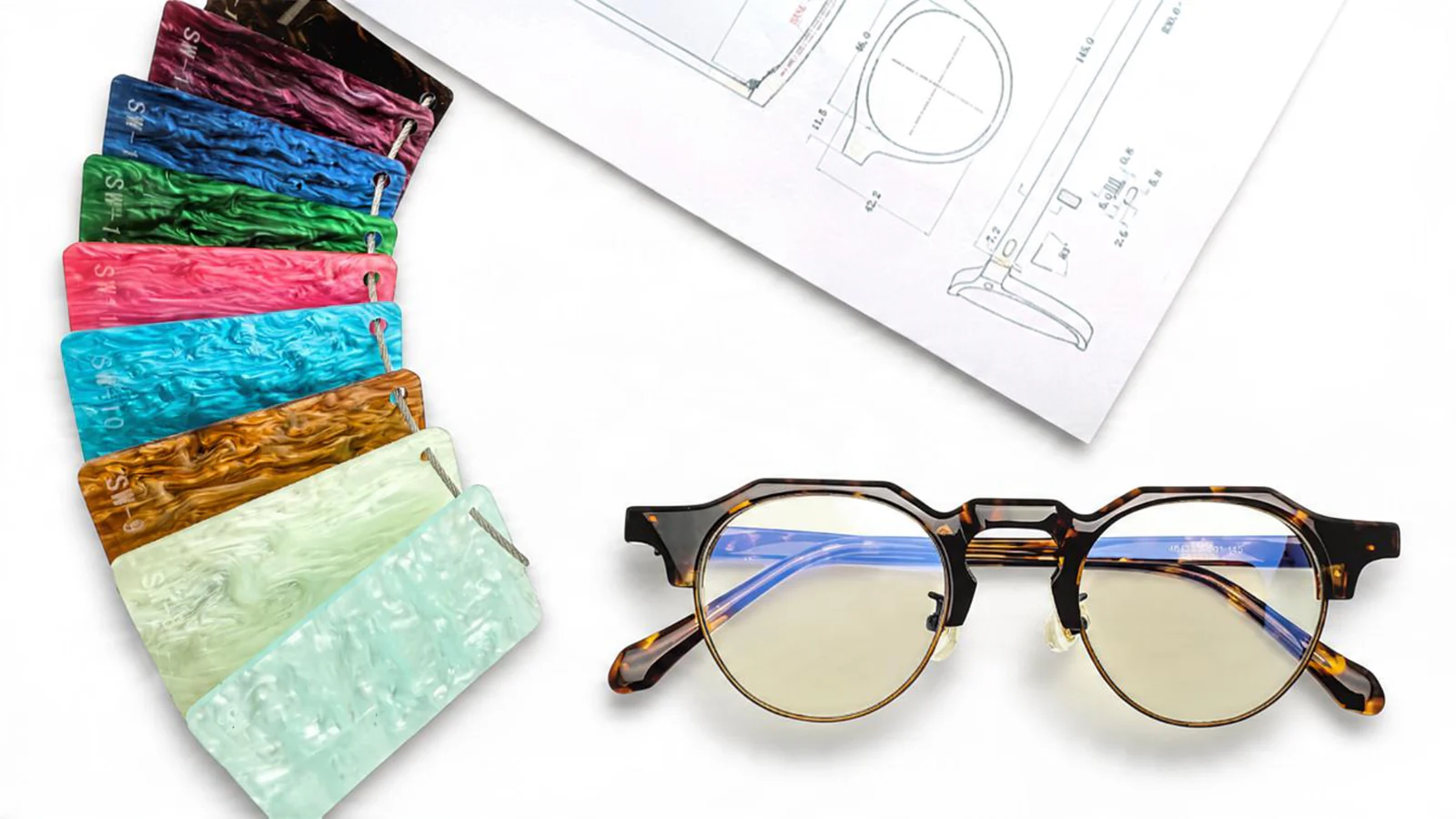
A complete CAD file is useful, but SEESUN can begin reviewing a sketch, product photograph, technical drawing or physical reference sample. The first task is to establish what the reference leaves unknown: frame geometry, lens parameters and the details of each joint.
A front-view image may establish the silhouette while concealing lens curvature, groove depth or the hinge seat. Side views, approximate dimensions and close-ups of joints make the first review more useful. CAD can define geometry precisely, but it cannot by itself prove that parts can be machined and assembled. A physical reference reveals thickness and hinge movement; a change of material may still require redesign. Buyers must also have permission to use reference designs. When a specified material or fitting is unavailable, decide whether the requirement is visual equivalence or the exact original component. A substitute should be reviewed for assembly and function, not accepted solely because it looks similar.
Define the elements that cannot change—perhaps the outline, bevel or distinctive endpiece—then clarify lens specifications, frame dimensions, material, intended wearer and construction details. The engineering review should follow the brand’s priorities: one customer may focus on fit, another on the visibility of a layered color boundary. Special hinges, unusual shaping and bespoke hardware should be assessed against the development budget and tooling schedule while changes are still possible.
In SEESUN’s development process, engineering drawings are prepared or refined and approved by the customer before the first physical sample is made. Approval of the drawing establishes the design to be sampled; approval of the finished frame is a later decision.
A buyer searching for a custom logo eyewear manufacturer may only need a logo applied to an existing, suitable frame. That belongs closer to the private label eyewear route. A new front curve, hinge connection or complex color construction requires a much broader engineering review.
The planned frame had a pronounced wraparound curve, a thick acetate front and sculpted endpieces. The customer’s references defined its exterior well enough to begin, but left the lens groove, inner rim and endpiece clearances unresolved.
Engineering found that the intended front curve did not fully match the specified lens geometry. Following the front-view outline alone could leave uneven groove engagement. During lens fitting, that mismatch could distort the frame, create gaps or, in a severe case, allow the lens to dislodge. Temple clearance at the endpieces also needed correction. These were identified risks, not defects reported from the approved production run.
The team matched the three-dimensional front to the actual lens parameters, checked groove continuity and adjusted the inner construction while retaining the main exterior profile. CNC/multi-axis machining used a controlled locating reference, followed by trial fitting with the intended lenses.
On the assembled sample, the team checked lens seating, groove engagement, symmetry and fit—none of which the original front-view reference could establish. After adjustments, fit and alignment improved and the customer-approved style entered mass production. For a curved design, buyers should approve the frame with its intended lenses fitted, not as an empty front.
One temple opened farther than the other on the first assembled sample, leaving an uneven gap at the hinge. The customer had asked for an acetate front, slim metal temples and clean material transitions. None of the separate components made the difference as obvious as the assembled frame did.
SEESUN reviewed endpiece thickness, the hinge-seat position, the angle of the welded or formed metal temple and surfaces affected by polishing. Small deviations from several operations were accumulating at the joint. An outer decorative edge was not a reliable reference for the hinge’s movement. Using the rotation axis as the working datum also gave machining, welding or forming, and final assembly a shared basis for checking the two sides.
The team revised the hinge location and metal-temple connection angle, allowed for polishing and used controlled positioning based on the hinge rotation axis. The complete assembly was checked for opening, closing, gap uniformity and symmetry.
After the hinge location and metal-temple angle were revised, the frame opened more consistently and required less fitting adjustment. The approved style entered mass production. This was a cumulative positioning problem across operations, which is why sunglasses prototyping must include checks on the assembled frame, not just the individual parts.
The buyer’s two-color acetate concept depended on a boundary running across a thick front and its angled outer surfaces. Reference images and basic dimensions showed the intended effect. They did not show exactly where to place the join before machining and polishing removed material.
Placing the join to match a flat rendering could move the visible boundary after shaping. Engineering therefore compared the thickness and position of each color section with the planned cutting path. Seams, whitening, bubbles and localized distortion also had to be considered.
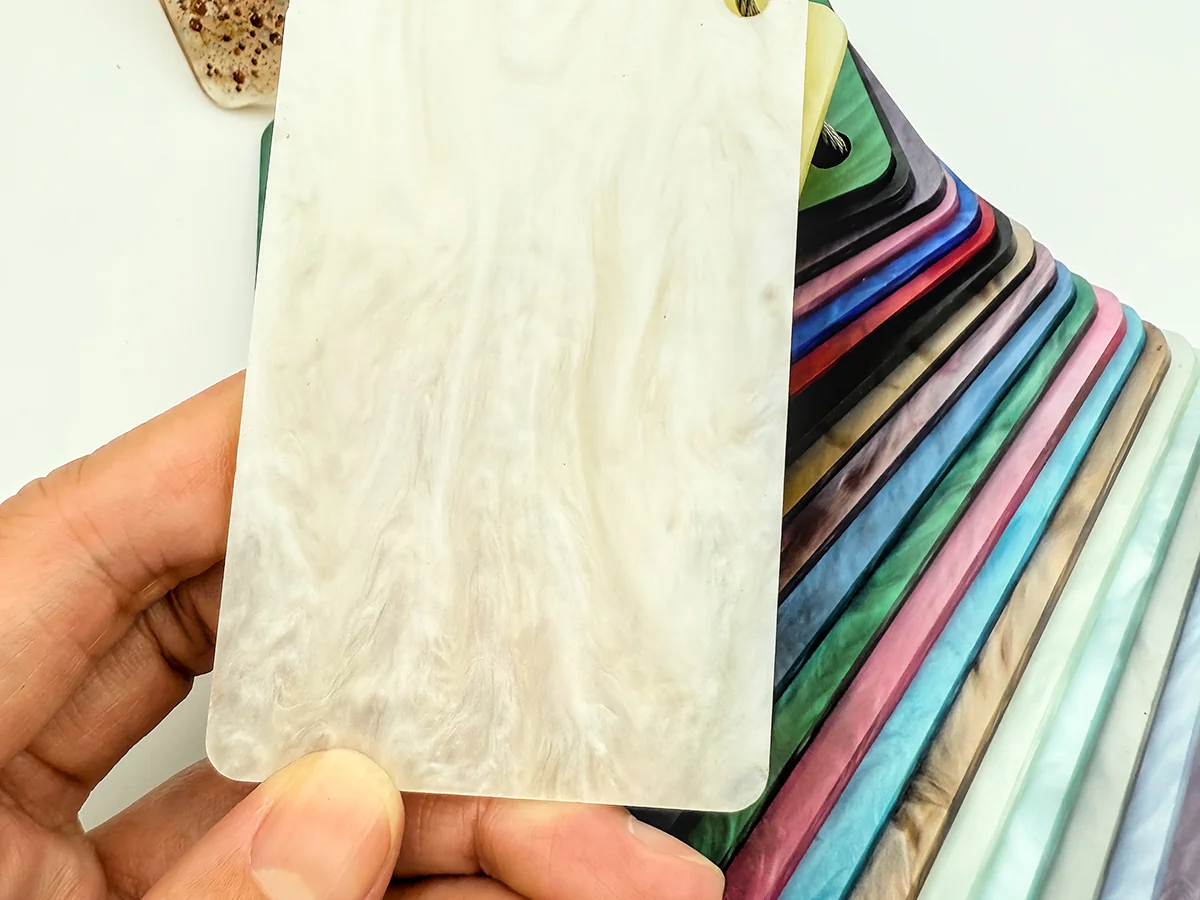
SEESUN used CAD sections to define the color interface, machining allowance and locating surfaces. Cold joining, high-frequency lamination and pre-combined material were considered according to the actual acetate. For complex curved faces, the team evaluated five-axis CNC and suction-fixture precision machining, including the risk of losing position between operations. Polishing allowance was part of the design review because it could change the exposed color ratio. The sequence of machining and clamping also mattered: repositioning a partially finished blank could shift the intended boundary.
The sample was viewed from the front and at 45 degrees to assess color placement, symmetry, seams, surface condition, dimensions and lens fit. If the boundary appeared to move across the beveled face, material positioning and the cutting path were revisited; polishing alone was not an acceptable way to hide the error. The approved design proceeded to mass production.
Approving a color rendering alone would leave an eyewear product development question unanswered: where must the join sit before machining to show the intended boundary after polishing? Ask a prospective custom eyewear manufacturer how that relationship will be controlled across the batch.
Sunglasses prototyping need not involve a set number of rounds. If the first sample meets the agreed requirements, it can be approved. Otherwise, identify exactly what the next version must correct and how the change will be assessed.
For an eyewear prototype, reviews should distinguish fit, construction, appearance and repeatability:
| Review area | Check on the physical sample |
|---|---|
| Fit and geometry | Bridge, front curve, temple opening and symmetry |
| Lens and assembly | Groove engagement, lens seating, hinge clearance and joint movement |
| Finish | Color placement, polishing, visible seams and decorative alignment |
| Reproducibility | Key dimensions and whether finishing changes the intended result |
A 3D-printed model can clarify difficult geometry before tooling, but it cannot replace a sample in the intended materials. Lens fitting, polishing and mixed-material joints require assessment in the real assembly.
Sample comments need a location and an observable symptom. “Too wide” could mean the front, endpiece or temple opening; “hinge feels wrong” could mean resistance, play or opening angle. Keep annotated photos, drawing revisions and sample identifiers together. Distinguishing a structural correction from a styling preference also clarifies which change needs physical testing. For buyers still choosing a sunglasses manufacturer in China, the quality of that investigation is useful evidence of engineering capability.
In custom eyewear development, a physical sample tests the approved drawing; it should not be used to fill in requirements that were never agreed.
In the custom sunglasses manufacturing process, approval must describe the product production will reproduce. A finished sample alone may not identify the correct drawing version, component specification or permissible variation.
The handover should identify the approved physical frame and drawing revision, critical dimensions, material and color references, lens and hinge specifications, finishing requirements and inspection points. Customer approval of the drawing authorizes sampling; approval of the finished sample establishes the production reference. A buyer working with a custom branded sunglasses manufacturer should approve fit, component function and critical dimensions separately from branding and packaging. A visually similar substitute component still needs an engineering and buyer review if its fit, function or performance could differ.
For difficult joints or surfaces, the team may need a locating fixture, a tooling modification or a limited pre-production check. The choice between modifying an existing part, machining directly and making new tooling depends on the construction, development cost, timing and intended quantity. Any special setup or inspection limit must be documented so the approved result does not depend on one sample technician’s memory. Engineering revisions can also affect sampling costs, tooling and production schedules; agree the revised scope and milestones before releasing the design.
Eyewear product development does not end with an approved sample; the released drawing must match it. Machining, assembly and QC teams need the same revision and the same critical dimensions. For the contractual allocation of approval authority, see OEM and ODM development responsibilities.
Production inspection should reflect the problems discovered in development. For the curved front, that means lens seating and alignment; for the mixed-material frame, hinge movement and gaps; for the patterned acetate, the color boundary after cutting and polishing. These requirements are more useful than a generic instruction to “check appearance.”
At each production handoff, the inspection reference should reflect what engineering corrected. SEESUN’s in-house engineering sampling, CNC/five-axis machining, acetate joining, precision engraving, tumbling, grinding, certain metal work and welding, polishing, assembly and inspection may each affect a different approved feature. Acetate sheets, lenses, hinges, core wires and screws are sourced, while some specialist operations involve external partners. The relevant check is whether the lens groove, hinge datum or color boundary remains within the agreed reference after that step. See SEESUN’s factory production and quality controls for the broader manufacturing route.
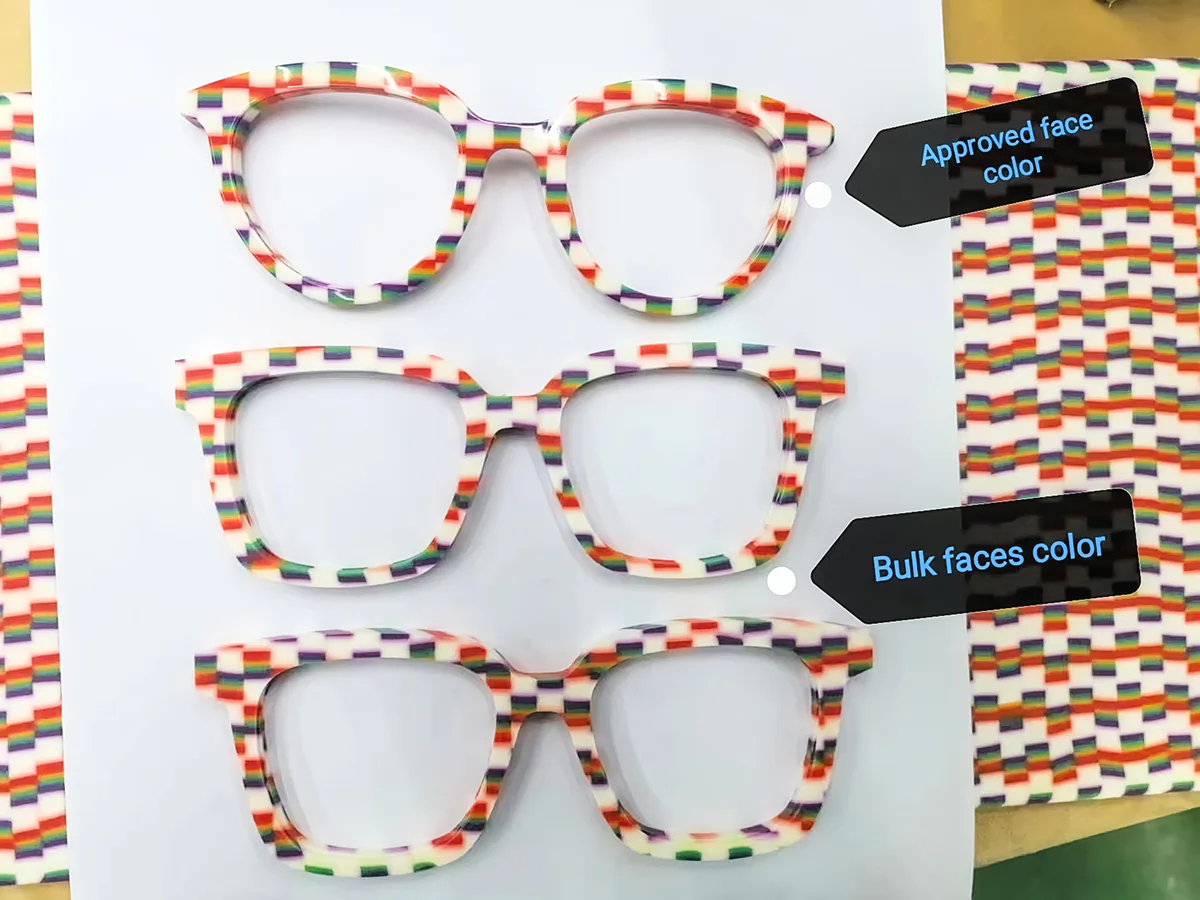
Incoming, in-process and final QC must use the approved references. The selected photo comparing sample and bulk acetate fronts can illustrate a visual color check, but does not establish numerical color tolerances or dimensional conformity. Those judgments require the agreed specification and appropriate inspection.
The work of custom eyewear development carries into production whenever approved geometry, materials and finishing details become measurable inspection requirements.
Production readiness is more than a successful first sample. The curved front, metal-temple joint and patterned acetate case required different engineering decisions, but all three needed a repeatable specification. That is what custom eyewear development should deliver: a design whose critical geometry, assembly and appearance can be followed beyond the sample room.
Have a sketch, CAD drawing or reference sample? Send the target market, intended material, lens requirements and design features that must remain unchanged. SEESUN can review what should be clarified before sampling.
We use cookies to support essential website functions. You can find details about the cookies used on this site in our Cookie Policy.