

How do your eyes work?
While the human eye is much more complex than any artificial machinery, it can be likened to a camera in simple terms. Light from the external world enters the eye through the pupil. The pupil adjusts its size to adapt to the level of brightness in the environment, allowing more or less light to enter the eye.
Light from the external world enters the eye through the pupil. The pupil adjusts its size to adapt to the level of brightness in the environment, allowing more or less light to enter the eye. At the back of the eye, the retina acts as the image sensor. Its surface is covered with approximately 120 million photoreceptor cells, which react to the intensity of light (these are called rods) and 6 million cells that enable us to see colors (these are called cones).
The light is focused on the retina by the lens, which is equivalent to the lens of a camera. When the lens has the right shape and is the appropriate length for the eye, sharp focusing on the retina produces a clear image. Like modern cameras, the lens includes an autofocus system. Muscles surrounding the lens can flex the eye to focus on close distances. A normal eye can see far distances without effort from the muscles, but these muscles contract when observing close distances. Imagine taking a close-up photo with a smartphone camera: sometimes it struggles to focus on the object up close, and our eyes are no exception!
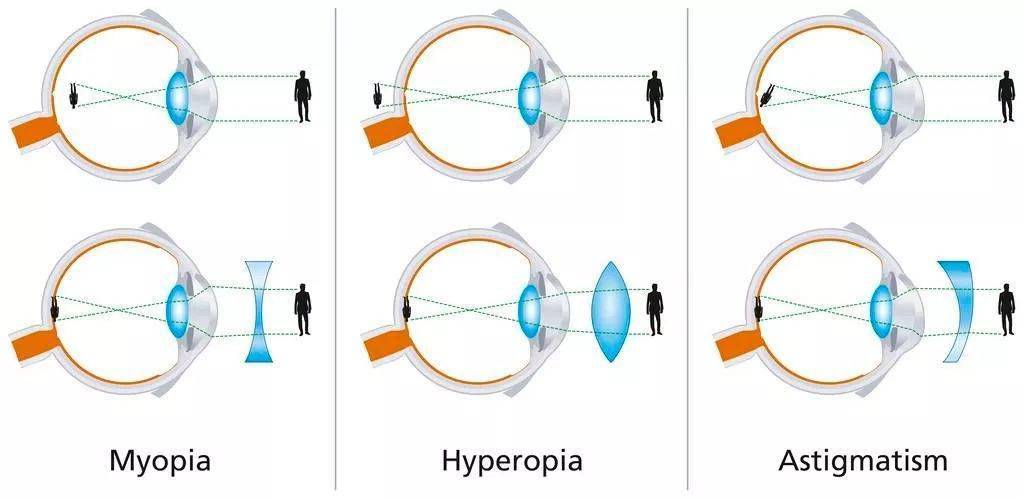
When we look at objects in the distance, the muscles of our eyes relax, causing the lens to become thinner, allowing light to focus correctly on the retina. This enables us to see distant objects clearly.
When we look at objects up close, the muscles of our eyes contract, causing the lens to become thicker in order to focus better on the nearby objects. This allows us to see details up close clearly.
In addition to the lens’s autofocus function, our eyes have other remarkable features. For example, our eyes can adapt to different levels of light intensity, allowing us to see clearly in both bright and dim environments. Furthermore, our eyes can perceive colors and motion, transmitting this information to the brain for processing and interpretation.
In summary, our eyes are intricate and complex organs that allow us to see the beauty and details of the world through the focusing of light and the response of photoreceptor cells.